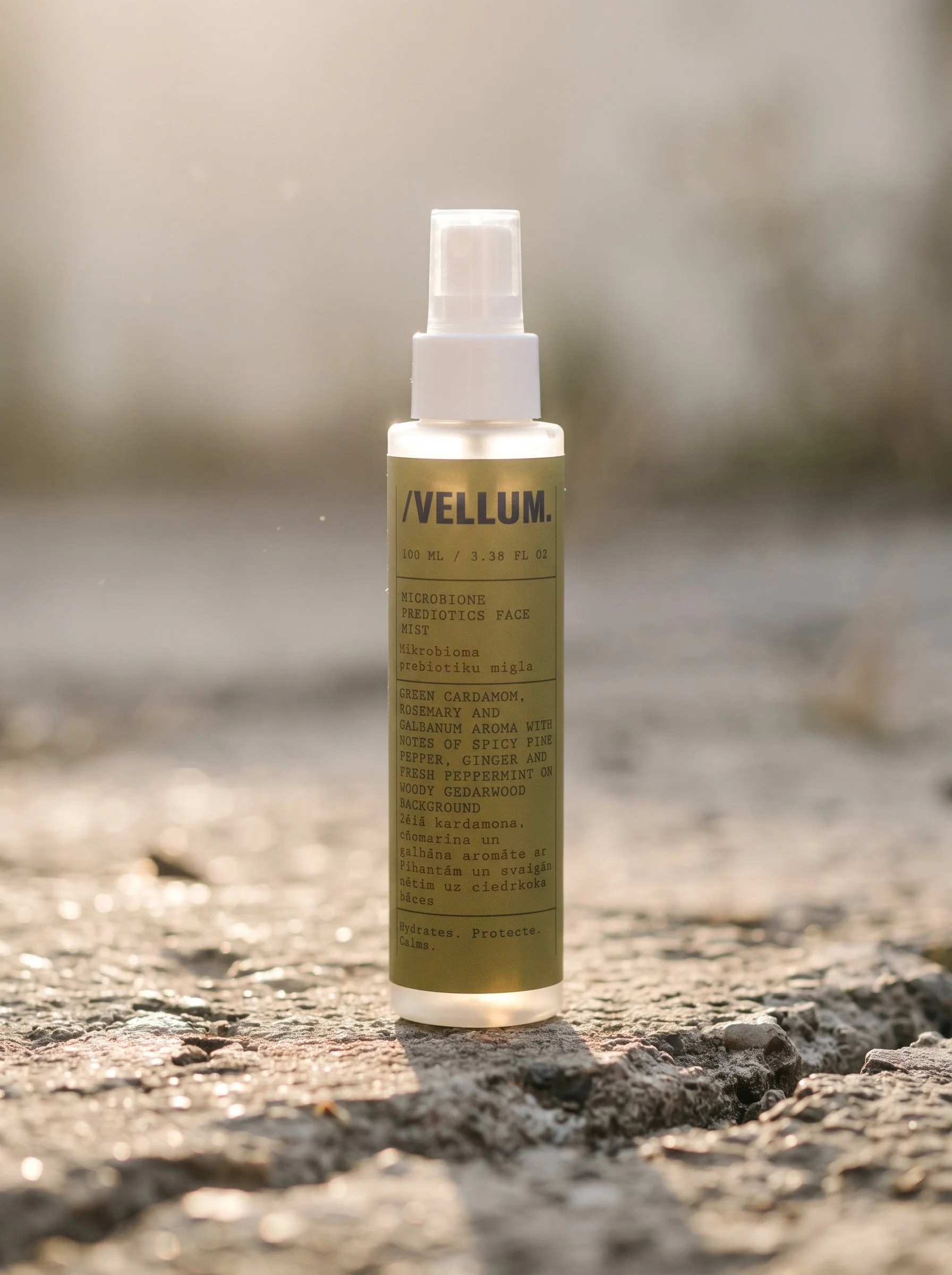
A moment to reset. A closer look at the ingredients behind it.
A closer look at prebiotic skincare—exploring the connection between your skin and its microbiome.
Your skin is home to more than meets the eye. Alongside its visible surface lives a community of microorganisms known as the skin microbiome. That community is part of the reason skincare conversations are shifting from simply cleansing the skin to understanding how to support its environment.
Enter prebiotics: ingredients being explored for their ability to support beneficial microorganisms already living on your skin. They offer an intriguing approach to skincare—but understanding what they actually do helps separate meaningful science from marketing.
What Are Prebiotics?
In simple terms, prebiotics are substances that certain microorganisms can use as nourishment, producing a benefit for their host—in this case, you. Scientists define a prebiotic as “a substrate that is selectively utilized by host microorganisms conferring a health benefit.”
The important word is selectively. A substance does not qualify as a prebiotic simply because bacteria can consume it. Researchers need evidence that particular microorganisms use it and that this activity delivers a health benefit.
Although prebiotics are often discussed in relation to digestion, the concept is not limited to the gut. It can also apply to other areas where microorganisms live, including the skin. However, evidence that an ingredient works as a dietary prebiotic does not automatically prove it delivers the same benefit in a face cream or mist.
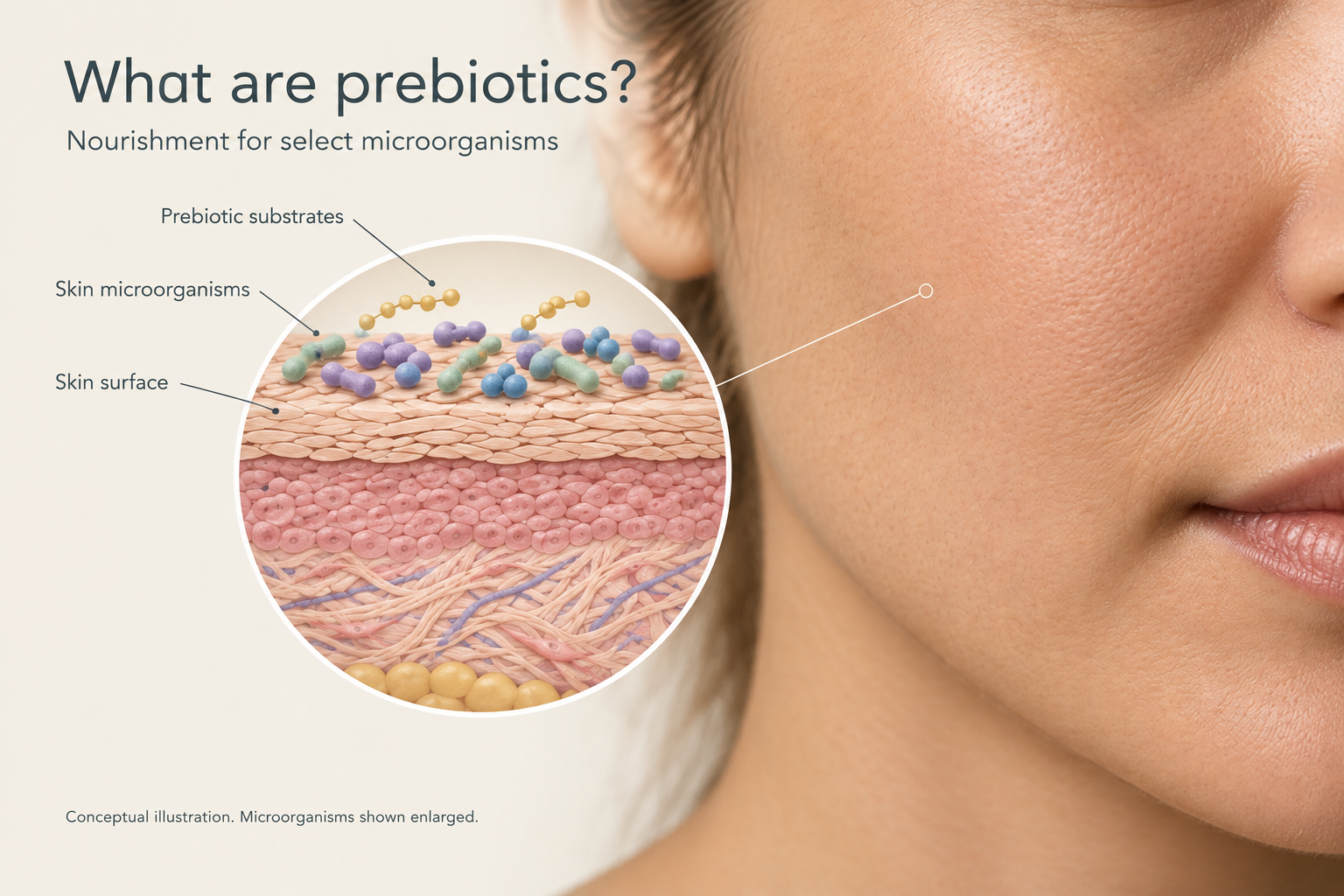
Prebiotics provide nourishment for select microorganisms—a concept illustrated here in a magnified view of the skin’s surface.
How Do Prebiotics Apply to Skincare?
Topical prebiotic skincare aims to support the microorganisms already present on the skin rather than introduce new, live bacteria. The idea is to provide selected microbes with substances they can use, potentially influencing the skin’s microbial community and its activity.
Think of it as tending an existing garden rather than planting an entirely new one. The goal is not to eliminate every microorganism, but to encourage conditions that support healthy skin.
That distinction matters because microbiome skincare is not simply about having “more good bacteria.” Scientists are still working to understand which microbial changes are beneficial, for whom, and under what conditions. A change in the microbiome alone does not necessarily demonstrate an improvement in skin health.
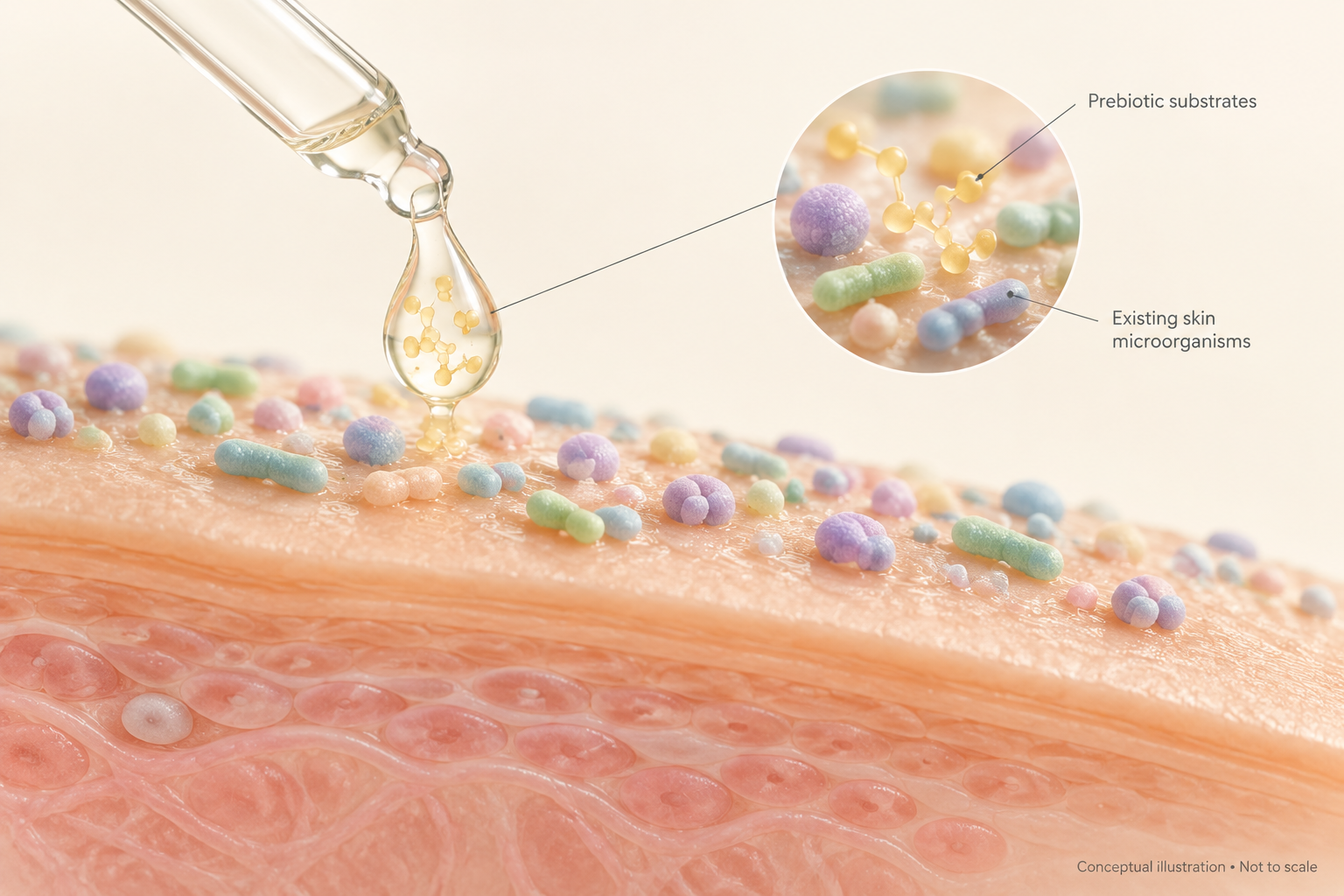
Topical prebiotics aim to nourish select microorganisms already living on your skin, rather than introduce new bacteria. Conceptual illustration, not to scale.
What Benefits Are Researchers Exploring?
Research into topical prebiotics has explored several areas:
Hydration: whether prebiotic-containing formulas can improve the skin’s moisture levels.
Barrier function: whether they can help support the skin’s protective outer layer.
Microbial activity: whether selected ingredients influence the growth or behavior of skin microorganisms.
Skin conditions: whether these approaches may eventually play a supporting role in managing concerns such as atopic dermatitis.
These are promising research directions, not guaranteed results from every product labeled “prebiotic.” Studies vary in their ingredients, formulations, duration, and participants. A recent review also notes that dedicated research on how topically applied prebiotic oligosaccharides work remains limited.

Exploring the potential of topical prebiotics for hydration, barrier support, and microbial activity—areas of ongoing research, not guaranteed results.
Are Prebiotics the Same as Probiotics?
No. The names sound similar, but they describe different approaches:
Prebiotics are substances selectively used by microorganisms to deliver a health benefit.
Probiotics are live microorganisms that provide a health benefit when administered in adequate amounts.
A simple way to remember the difference: prebiotics provide nourishment, while probiotics provide live microorganisms.
This is also why a prebiotic product does not need to contain live bacteria to fit the concept. Its intended action involves microorganisms already present on the skin.
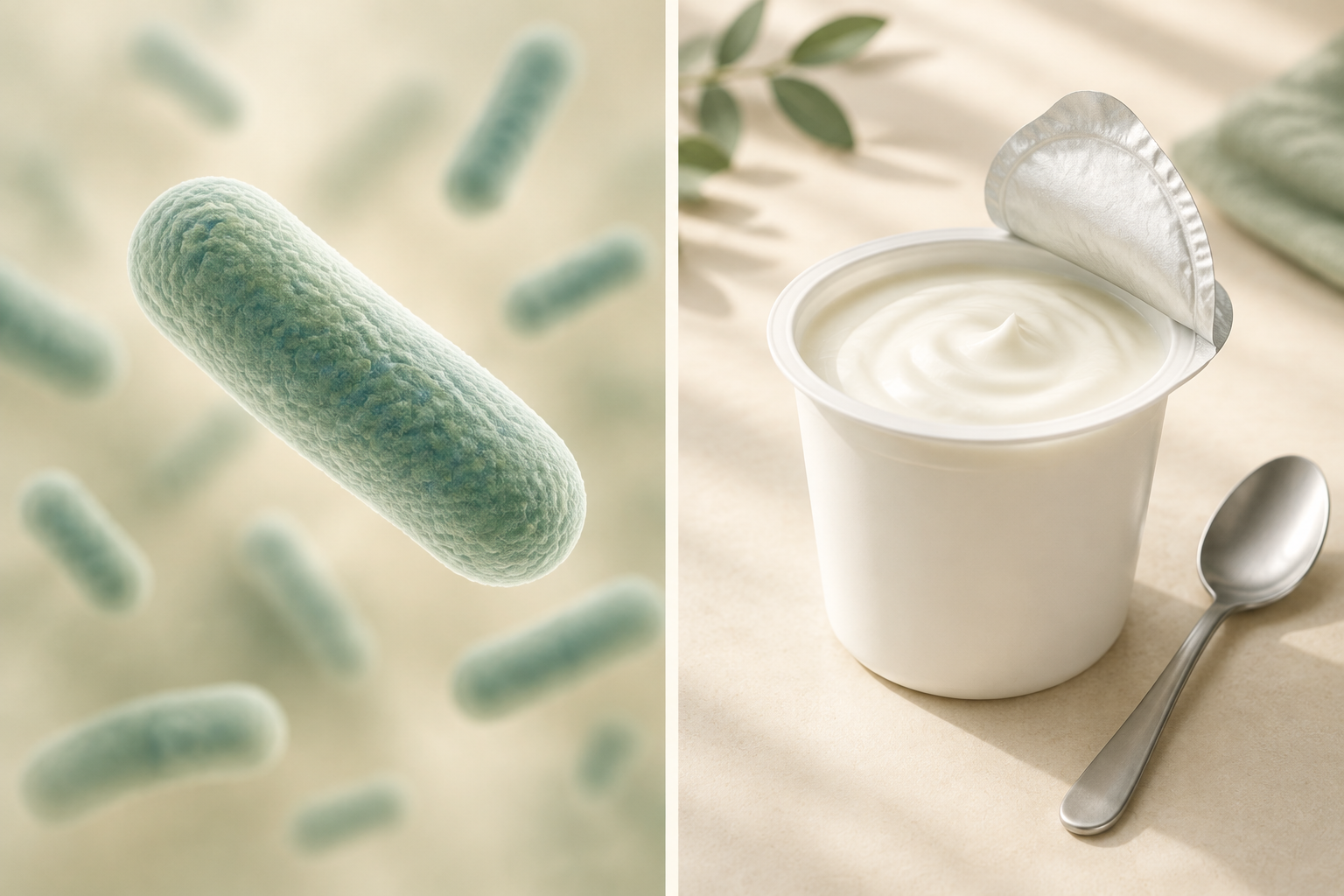
A closer look at microorganisms: a conceptual magnified illustration alongside a container of plain yogurt.
What Should You Expect From Prebiotic Skincare?
Think of prebiotic skincare as an emerging formulation approach—not a promise to “reset” your skin.
Some studies suggest potential benefits, but the evidence does not support treating all prebiotic products as interchangeable. Results from one ingredient or tested formula cannot automatically be applied to every serum, moisturizer, or facial mist using similar language.
The most useful question is not simply, “Does this product contain a prebiotic?” It is, “What has this particular formula been shown to do?”
A claim about improved hydration is different from a claim about changing the microbiome. Likewise, a cosmetic product marketed for microbiome support should not be assumed to treat acne, eczema, or another skin condition. Those applications require stronger, condition-specific evidence.
A More Thoughtful Way to Understand Skin Balance
Prebiotics bring an interesting perspective to skincare: the skin’s surface is a living environment, not an empty canvas.
The science suggests there may be value in supporting the relationship between skin and its resident microorganisms. But the strongest approach combines that curiosity with realistic expectations—looking beyond a trending ingredient to the evidence behind the finished formula.