A moment to reset. A closer look at the ingredients behind it.

A moment to reset. The /VELLUM. Microbiome Prebiotics Face Mist brings a refreshing pause to your everyday ritual.
Skincare doesn’t always need another complicated step. Sometimes, it needs a lighter touch—a refreshing layer of moisture after cleansing, over makeup, or somewhere between the demands of the day.
VELLUM’s Microbiome Prebiotics Face Mist brings that idea into a weightless formula. With Lactobacillus Ferment Lysate, Hyaluronic Acid, Sodium PCA, and Betaine, it pairs microbiome-inspired care with ingredients chosen for hydration.
Here’s what those ingredients bring to the ritual—and what microbiome skincare actually means.
First, what is the skin microbiome?
The skin microbiome is the community of microorganisms that lives on the skin’s surface. These organisms form part of a complex ecosystem that interacts with the skin and its protective barrier. Microbiome-focused skincare explores how cosmetic ingredients might support that environment.
It’s an evolving area of research, not a promise that one product can create a “perfect” balance. Studies of microbiome-focused formulas show potential, but results depend on the ingredients, the finished formulation, and the people using it.
For your everyday ritual, the takeaway is simple: think supportive care, not a microbiome makeover.
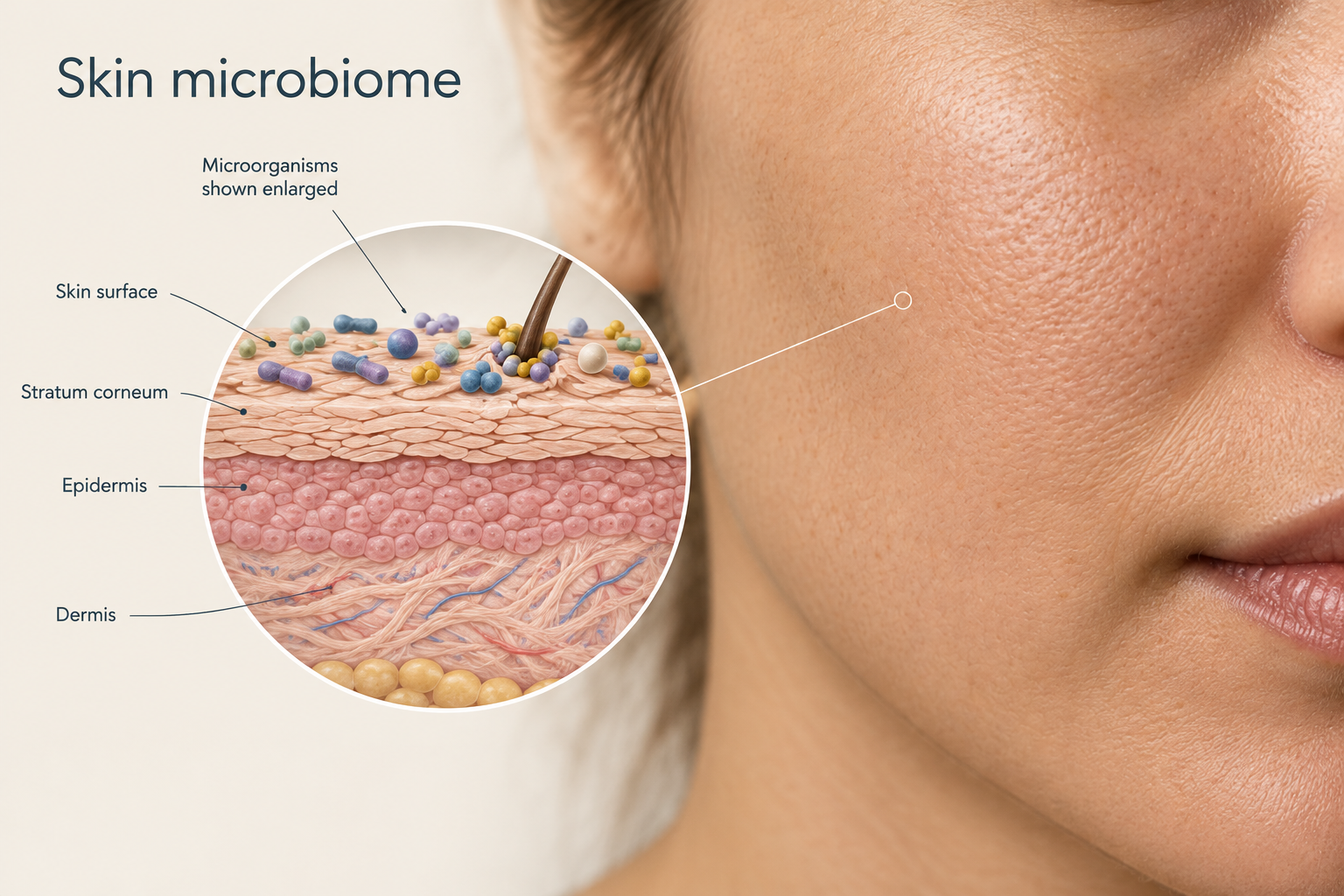
A closer look at the skin microbiome: an illustrative view of microorganisms on the skin’s surface, shown enlarged above the underlying skin layers. Not to scale.
Lactobacillus Ferment Lysate: the fermentation connection
One of the mist’s featured ingredients is Lactobacillus Ferment Lysate, a fermentation-derived ingredient.
Despite the association between Lactobacillus and probiotics, a lysate is not the same as a live bacterial culture. It contains material from broken-down microbial cells, rather than living bacteria intended to colonize the skin. Ferments and lysates are commonly used in microbiome-inspired cosmetics.
That distinction matters. Prebiotics are substances selectively used by beneficial microorganisms; probiotics are live microorganisms. A ferment lysate belongs to a different ingredient category, even when it appears in a product described as prebiotic skincare.
Research on certain Lactobacillus-containing lysate formulations has explored hydration and barrier support. Those findings are promising, but they don’t establish identical benefits for every product containing a similarly named ingredient.
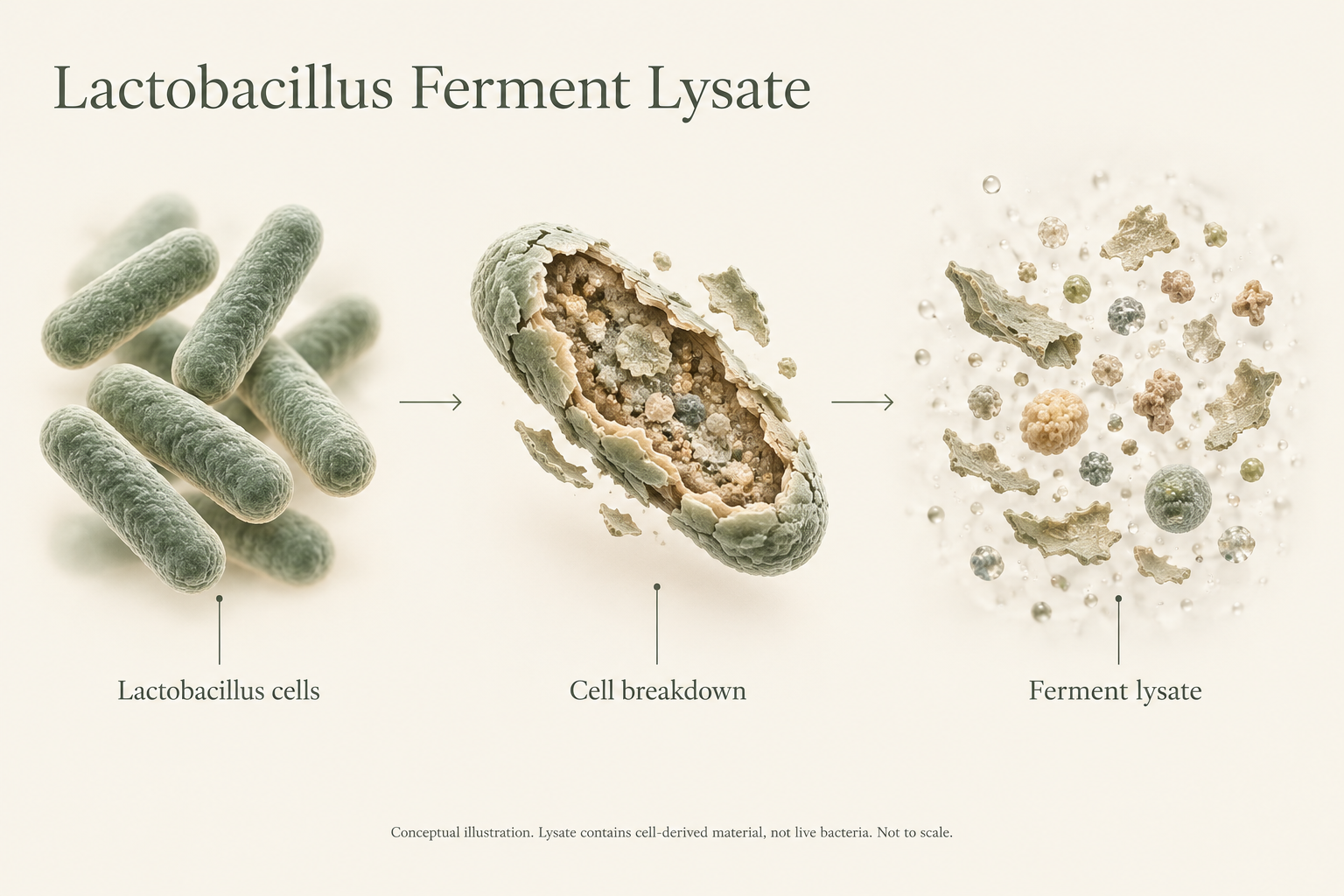
From fermentation to formula: a conceptual illustration of Lactobacillus Ferment Lysate, showing cell-derived material rather than live bacteria. Not to scale.
Hyaluronic Acid: a familiar hydration essential
On the mist’s ingredient list, you’ll find Hydrolyzed Hyaluronic Acid and Sodium Hyaluronate, forms associated with the Hyaluronic Acid family.
These ingredients act as humectants: they attract and bind water, helping support hydration in the outer layers of the skin. That makes them useful in a lightweight formula designed to deliver moisture without the richness of a cream.evigrade+1
Think of this as a hydrating layer within your routine—not a replacement for your moisturizer.
Sodium PCA: moisture support with a skin connection
Sodium PCA is part of the skin’s natural moisturizing factor—the collection of substances that helps the outermost layer hold onto water.
In skincare, it works as a humectant, attracting and binding moisture to help maintain hydration. It complements other water-binding ingredients rather than asking a single ingredient to do all the work.
In this mist, Sodium PCA sits alongside Hyaluronic Acid, Betaine, and Glycerin as part of the formula’s hydration-focused ingredient blend.
Betaine and Glycerin: supporting the hydration story
Betaine and Glycerin may be less prominent on the front label, but they have an important role in the formula.
Both are humectants, helping attract and retain water in the skin’s outer layer. Their inclusion adds to the mist’s moisture-focused approach: several complementary ingredients, brought together in one lightweight step.
The intention isn’t a heavier routine. It’s a refreshing way to add a little hydration to the routine you already have.

A refreshing veil of hydration. Hyaluronic Acid helps attract and retain moisture, bringing a replenishing touch to your daily misting ritual.
Where the mist fits into your day
Use the Microbiome Prebiotics Face Mist as a small pause in your daily ritual:
After cleansing, before continuing with your serum and moisturizer.
Over makeup for a refreshing finish.
During the day, whenever you want a light mist of moisture.
Close your eyes before misting and avoid direct contact with the eyes. For your morning routine, keep sunscreen as its own essential step.
A considered note on the formula
The Microbiome Prebiotics Face Mist contains alcohol and fragrance. If you have known sensitivities to either, review the full ingredient list before introducing it into your routine. Discontinue use if irritation occurs.
Microbiome-inspired doesn’t mean every formula will suit every skin type. Choosing skincare thoughtfully includes paying attention to the whole formula—not just its headline ingredients.
A fresh addition to your ritual
The appeal of the Microbiome Prebiotics Face Mist is its simplicity: a weightless texture, a refreshing application, and a blend of moisture-attracting ingredients.
A little hydration. A moment to reset. An easy return to your day.